GTA 6 vs Work: Will Launch-Day Absences Really Cost America $1 Billion?
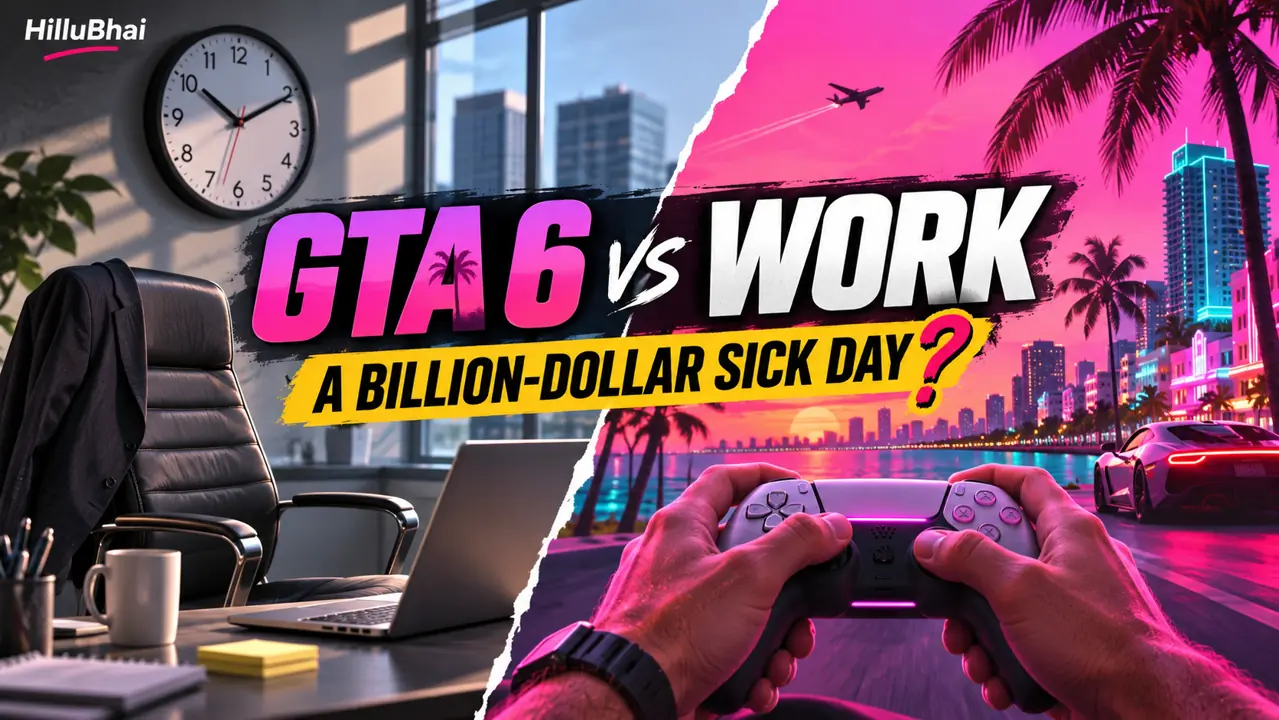
The office chair is empty, the controller is charged, and Vice City is calling. But could taking a day off for Grand Theft Auto VI actually damage the U.S. economy? Alongside our GTA 6 release date and price guide, here is a closer look at the workplace debate—and why the biggest number in the headlines deserves scrutiny.
GAMING MEETS THE ECONOMY • NOVEMBER 19, 2026
Some fans plan to miss work. A $1 billion national loss remains unproven. Time-off requests, survey answers and measured economic damage tell different stories.
First, when does GTA 6 arrive?
Rockstar’s announced release date is Thursday, November 19, 2026, for PlayStation 5 and Xbox Series X|S. Rockstar Support lists midnight local-time availability. That weekday launch gives the debate a straightforward trigger: many fans must choose between their normal schedule and playing immediately.
For a dedicated player, an uninterrupted first session can feel like an event worth planning around. The interesting question is how those individual plans translate into workplace disruption—and whether that disruption can support a nationwide dollar estimate.
Yes, there is evidence of extra time-off interest
BambooHR’s October 22 report found that the paid-time-off request rate for November 19 was nearly 13% above equivalent days in previous years. Its platform dataset covered more than 3.4 million active U.S.-based employees across 2024–2026.
Separately, its survey of 1,530 full-time U.S. employees found that 18% planned to take the launch day off. These are two different measures: platform requests and people describing their intentions. A 13% relative rise in requests does not mean an additional 13% of the entire workforce will be absent.
GameSquare’s October 20 research surveyed 1,000 full-time U.S. employees who identified as gamers. Ten percent said they planned to skip work on launch day; another 30% were considering time off. Because the respondents were employed gamers, those percentages should not be casually applied to every American worker.
The numbers worth keeping separate
| Figure | What it describes | What it cannot prove |
|---|---|---|
| Nearly 13% higher | BambooHR’s relative increase in the PTO request rate | A national count of extra absences |
| 18% | Launch-day leave intentions in BambooHR’s employee survey | Actual attendance on November 19 |
| 10% | GameSquare’s employed-gamer respondents planning to skip work | The same share of all U.S. workers |
| $1 billion | A widely circulated productivity-loss claim | A verified economic result |
Where the billion-dollar claim runs into trouble
PolitiFact’s November 18 investigation found no official survey or published study establishing the paired claims that 1.5 million workers would stay home and $1 billion would be lost. It traced conflicting reporting about the figures and their attribution.
That finding leaves room for genuine disruption while rejecting false precision. There is a substantial gap between saying a major release could affect attendance and declaring that a particular amount of national production will disappear. An impressive-looking calculation still needs a defensible starting headcount.
An empty desk does not automatically mean lost annual output
Consider a hypothetical employee who would normally take Friday off but instead books Thursday for the launch. The office experiences a different attendance pattern, yet the person’s total annual leave stays the same. Counting Thursday as entirely new lost work would overlook that change of timing.
A second hypothetical employee finishes a report early and takes approved leave. A third unexpectedly misses a shift that cannot easily be covered. These situations create different operational consequences. Multiplying every absent person by the same assumed daily output treats them as identical when they are not.
This is an analytical illustration, not a measurement of GTA 6’s actual impact. To estimate a net loss, researchers would need to distinguish additional absences from rescheduled leave, identify unfinished work and examine whether production was recovered later.
Small teams could still feel a big squeeze
National totals can hide local problems. In a hypothetical five-person customer-support team, two simultaneous absences could create a difficult day even if the wider economy barely notices. A shop might need shift coverage; an office might rearrange a meeting. The cost depends on the work, available substitutes and whether deadlines move.
That makes advance planning more useful than dramatic predictions. Managers can review overlapping leave requests, organise handovers and protect essential coverage. Players can request leave honestly and follow workplace policies. A predictable entertainment event is easier to accommodate when nobody has to guess who will turn up.
Game spending complicates the story too
A launch can redirect household spending toward games and related purchases. That creates business activity, but it does not establish that every dollar is an extra dollar for the U.S. economy. Some spending may replace another purchase, and the location of production matters.
Likewise, a publisher’s sales cannot simply be subtracted from a guessed productivity bill to produce a reliable national balance sheet. Revenue, value added, employee time and consumer enjoyment describe different things. A credible economic assessment needs consistent definitions on both sides.
So, will GTA 6 hurt the U.S. economy?
The strongest supported answer is that some workers intend to take time off and the launch coincides with elevated leave requests. The evidence reviewed here does not establish a $1 billion national loss or a confirmed launch-day absence total.
GTA 6 may give individual workplaces a scheduling headache. Whether it materially reduces overall economic output requires evidence beyond pre-release surveys and viral arithmetic. Enjoying a major release and meeting work commitments can coexist through an ordinary, properly planned day off.
Reporting basis: Rockstar Games release announcement and regional release-time guidance; BambooHR, October 22, 2026; GameSquare, October 20, 2026; PolitiFact, November 18, 2026. Survey intentions are not observed launch-day attendance. Economic examples are HilluBhai’s explanatory analysis. Featured image: original AI-generated editorial illustration, not official Rockstar artwork or gameplay.




1 comment